Why Sundials Run a Quarter Hour Off in Autumn
Par Sam Arkwell · publié le 3 octobre 2026
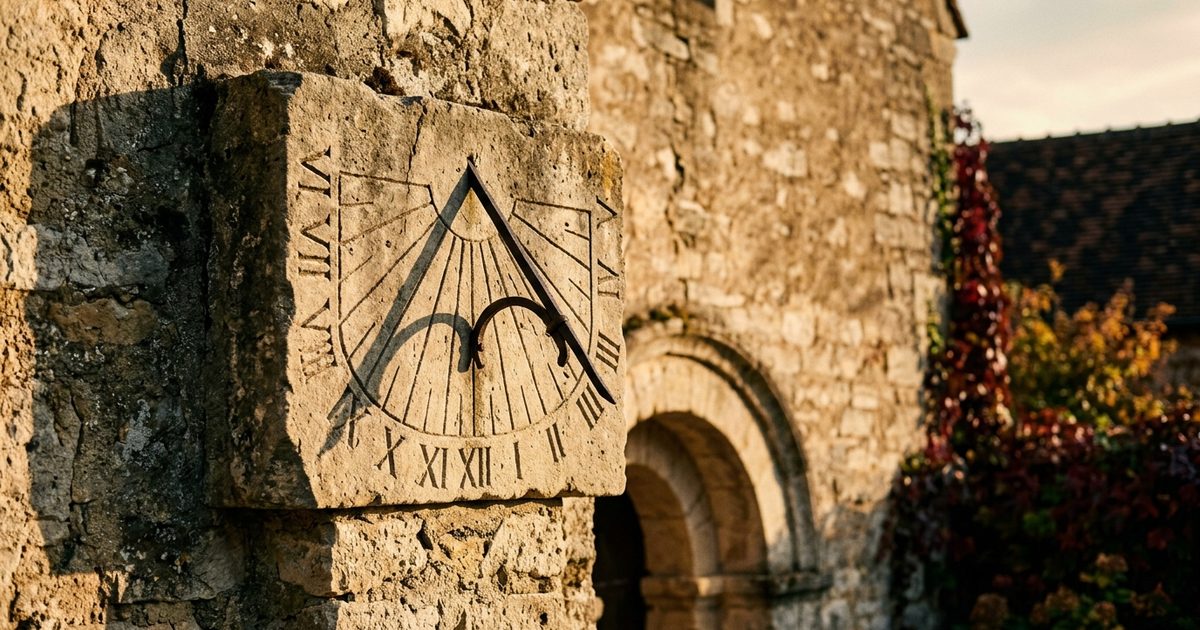
It has kept time on church walls and garden pedestals for centuries. Yet anyone who checks it against a watch suspects it of old age. The sundial runs fast, or slow, in any case wrong. The suspicion is unfair. It is the watch that tells a polite fiction, and the gap between the two, which peaks in a few weeks, obeys one of astronomy’s most elegant mechanisms, the equation of time. Autumn is its showcase season, which makes this the right moment for the explanation.
Why do sundials and clocks disagree?
The short answer: three offsets stack up. The time zone first, since most places live on a reference meridian that is not their own, a whole hour or more of built-in shift. Longitude next, the sun culminating 4 minutes later for every degree you move west within the zone. And the equation of time, the subtle one: the true sun runs ahead of or behind mean clock time through the year, between roughly +14 and −16 minutes, with its record lead hit in early November. The sundial reports the real sun ; the clock reports an averaged convention.
The equation of time deserves the full story, because it is the scholarly heart of the matter. Our clocks assume equal solar days of exactly 24 hours, and nature delivers no such thing, a true solar day almost never lasts 24 hours, for two superimposed reasons. Earth’s orbit is an ellipse: the planet speeds up when closest to the sun, in northern winter, and slows at the far end, stretching and squeezing the true days. And Earth’s axis is tilted, which modulates how much of the sun’s apparent motion projects onto the celestial equator, a second pendulum. Their sum is the famous equation-of-time curve. It swings between about +14 minutes of solar lag in February and −16 minutes of solar lead in early November. It crosses zero four times a year, tabulated to the day by ephemeris services such as NASA’s sky pages.
Autumn is its spectacular season, and a famous paradox follows. In early November the true sun culminates a good quarter hour before mean noon, its biggest lead of the year. That is why the earliest sunsets arrive weeks before the December solstice, the afternoon sun already running ahead of the clocks even as the days keep shortening on their own schedule. November’s sky cheats fast, February’s cheats slow, and the solstice only holds the record for shortness, not for either horary extreme.
Reading a sundial like a dial maker
Reading a dial correctly takes three corrections, in order. The zone first: add the offset between local standard time and the zone’s reference meridian, daylight saving included where it applies, the late-October clock change simply switching that correction by an hour. Longitude second, 4 minutes per degree from the reference meridian, west subtracting, east approaching the mark. The equation of time last, from a table of the day. On handsome old dials, it hides in the figure-eight curve engraved right on the stone, the analemma, the signature of learned dial makers who folded the whole year’s correction into a single loop.
The exercise is worth doing once, on a weekend walk this very season, precisely because the gap is near its peak. A garden or church dial, a watch, three corrections. And the time lands true to the minute, a small miracle of celestial mechanics available on any stroll, with the Hunter’s Moon due to decorate the other end of the sky. You come back with fresh respect for both instruments, the dial that tells the sky as it is, the watch that tells time as we organized it, and for the gap between them, which is not an error. It is the orbit’s signature, sixteen minutes of ellipse visible to the naked eye on a stone wall.
Vos questions
Why doesn't a sundial show clock time?
Three stacked offsets: the time zone, since most places live on a meridian that isn't their own ; the longitude of the spot, the sun culminating 4 minutes later per degree westward ; and the equation of time, the true sun's lead or lag on mean clock time, which swings between roughly +14 and −16 minutes through the year. The sundial tells true solar time, the watch tells an administrative average.
What is the equation of time?
The gap between true solar time, the sundial's, and mean solar time, the clock's: it comes from Earth's elliptical orbit, which speeds up near the sun, and from the tilt of its axis. The gap oscillates between about +14 minutes in February and −16 minutes in early November, crossing zero four times a year.
Why is the sun ahead of the clock in autumn?
In early November the true sun culminates about 16 minutes before mean noon, its biggest lead of the year: Earth is approaching its closest point to the sun and accelerating along its orbit, while the axial tilt adds its own effect. That's why the year's earliest sunsets come weeks before the winter solstice instead of coinciding with it.
How do you read a sundial correctly?
Apply three corrections: add the time zone offset, including daylight saving where it applies ; adjust for longitude, 4 minutes per degree from the zone's reference meridian ; and apply the day's equation of time from a table. Many old sundials engrave that correction as a figure-eight curve, the analemma, the signature of learned dial makers.