October's First Meteor Shower Peaks Right After Nightfall
Par Sam Arkwell · publié le 1 octobre 2026
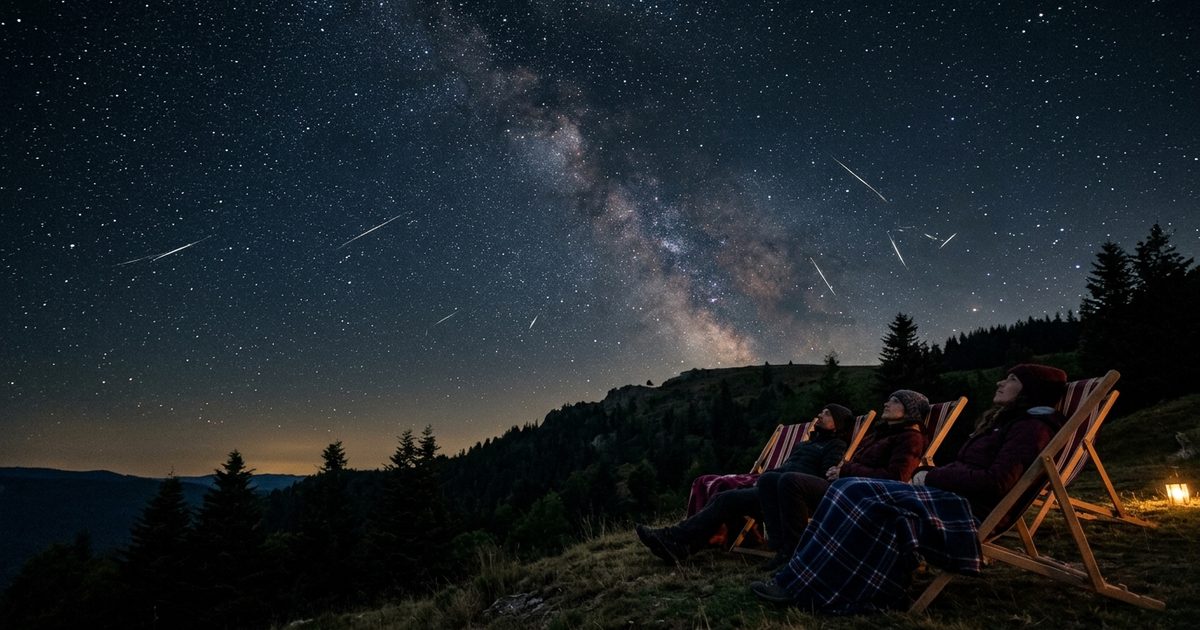
October’s nights open with a gift for everyone who loves shooting stars but hates alarm clocks. The month’s first meteor shower peaks next week with a quirk that makes it precious, it performs before bedtime. The Draconids, expected to peak around October 8 and 9, are the one notable shower of the year that favors early evening over the brutal small hours, and the lengthening nights of early October provide the best seats of autumn. Here is the complete viewing guide.
When and how to watch the Draconids?
The short answer: around October 8 and 9, as soon as darkness falls, and that schedule is the whole luxury. The shower’s radiant, the point its meteors appear to stream from, sits in the constellation Draco, high in the northern sky at dusk, so the best window runs from nightfall to around midnight, unique among meteor showers. The display is modest, a few to ten meteors per hour under dark skies, but this shower’s history is packed with spectacular surprises, and nobody watches it for nothing.
The schedule deserves its explanation, because it reverses every habit. Most meteor showers peak after midnight, when Earth’s rotation turns the observer into the oncoming stream of dust, hence the famous 2 a.m. vigils of August. The Draconids are the geometric exception: their radiant in Draco, a circumpolar constellation, rides high in the north right at dusk and sinks through the night instead of climbing. Prime time therefore runs from full darkness, around 8 p.m. in early October, to midnight, and the early sleeper’s shower fully earns its nickname.
The source is a comet, 21P/Giacobini-Zinner, whose dust trail Earth crosses every year in early October. Each grain entering the atmosphere burns up as a streak of light, and Draconid meteors are known for being slow by meteor standards, leisurely streaks that are a pleasure to follow. The precise forecasts belong to the ephemeris institutes and sky-watching services, including NASA’s observing pages, which track the shower’s yearly prospects.
A modest shower with a spectacular past
Honesty requires calibrating expectations: an ordinary Draconid year is a quiet affair, a handful to ten meteors per hour under a properly dark sky, nothing like August’s great displays. The legend comes from elsewhere. This is the most temperamental shower on the calendar, and its historical outbursts rank among the greatest sky spectacles ever documented, genuine storms of thousands of meteors per hour in certain twentieth-century years, when Earth plowed through a dense, freshly laid filament of comet dust. Such outbursts remain hard to predict, which is exactly the charm, and devoted observers check this shower every single year precisely because it likes surprises.
The viewing method works for every shower of the month. Escape the lights first: the difference between an urban and a rural sky is counted in multiplied meteors, and even a dark park helps enormously. Adapt your eyes next, 15 to 20 minutes without screens, a single phone check undoing the night vision you built. Watch wide, lying back or in a deck chair, no instruments, binoculars and telescopes narrowing exactly the field you need broad, since meteors can flash anywhere. Add October equipment, a blanket and something hot, the season of long nights having begun its serious work.
The month’s sky offers a full program around the shower: the moon still visible in daylight in these first days, the Draconids in the first third, then the build-up to late October’s Orionids, the month’s other shower, richer and more night-owlish. Early-falling darkness has its compensations, and the first week of October delivers one that asks only for a clear sky, patient eyes, and a view to the north.
Vos questions
When can you see the Draconid meteor shower?
The peak falls around October 8 and 9, and the Draconids' claim to fame is their schedule: unlike almost every other meteor shower, they are best watched in the early evening, right after darkness falls, because their radiant point sits high in the sky at dusk. No 3 a.m. alarm required, this is the early sleeper's meteor shower.
How many meteors do the Draconids produce?
In a normal year, the shower is modest: a handful to ten meteors per hour under a dark sky, far from August's great displays. Its reputation comes from history: the parent comet has occasionally produced genuine meteor storms, thousands per hour, with little warning, which is why observers faithfully check this unpredictable shower every year.
What causes the Draconid meteor shower?
Dust from comet 21P/Giacobini-Zinner, whose trail Earth crosses every year in early October: each grain burns up in the atmosphere as a streak of light. The name comes from the constellation Draco, the Dragon, from which the meteors appear to radiate, high in the northern evening sky.
How do you watch a meteor shower properly?
Three rules: escape artificial light, a dark park or countryside multiplying what you see ; give your eyes 15 to 20 screen-free minutes to adapt to darkness ; and watch wide, lying back without fixing a point, since meteors can appear anywhere. No equipment: binoculars and telescopes narrow exactly the field you need wide.