October Starts Tomorrow and Its Name Is a 2,000-Year-Old Error
Par Sam Arkwell · publié le 30 septembre 2026
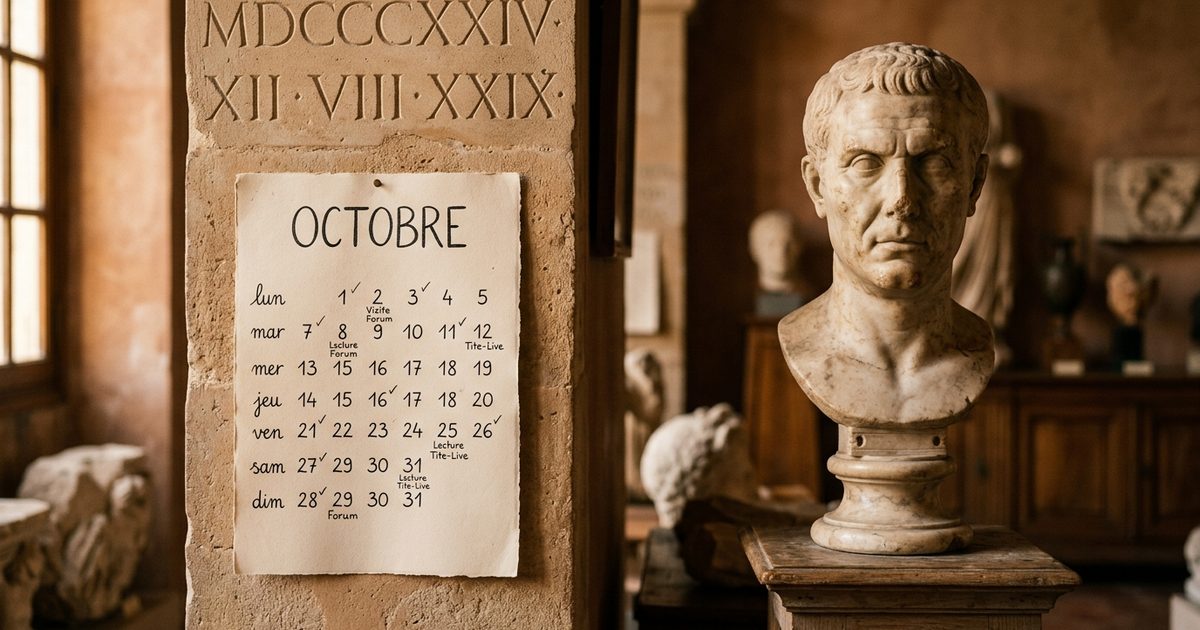
Tomorrow morning, the whole world flips its calendar to a month whose name calmly states a falsehood. October comes from octo, the Latin for eight, and October is the tenth month of the year. That little lie on the label is more than two thousand years old, has a perfectly clean explanation, and carries a delicious moral about the errors humanity chooses never to repair.
Why does the tenth month wear an eighth month’s name?
The short answer: because the early Roman year began in March. In that calendar, October genuinely was the eighth month, September the seventh, November the ninth and December the tenth, their names simply stated their rank. When January and February were installed at the head of the year, every month slid two places down the line, and in two millennia nobody has thought it worth renaming the four stragglers.
The original calendar, credited by tradition to Romulus, ran ten months from March to December, opening with spring and the campaign season, hence the month of Mars. Its last four months wore numbers instead of names, September, October, November, December, seventh through tenth, bureaucratic labels of the plainest kind. Winter, remarkably, was a hole, roughly sixty days that belonged to no month at all, which says everything about early Rome’s pragmatic view of time, why count what you cannot farm or fight in.
The reform attributed to King Numa Pompilius filled the gap with January and February, and the year eventually opened in January, the month of Janus, the two-faced god who looks at the year behind and the year ahead, a symbol too perfect to resist. The shift was born, the numbered months slid two ranks, and their names stayed put. The English-speaking world, for its part, took until 1752 to move New Year’s Day from March 25 to January 1, alongside its late adoption of the Gregorian calendar, proof that calendars change at the speed of habit, not of logic.
Two months got fixed, four got forgotten
The sharpest twist in the story is that two numbered months were renamed. Quintilis, the fifth, became Julius in honor of Julius Caesar, reformer of the calendar, our July. Sextilis, the sixth, became Augustus for Emperor Augustus, our August, whose legendary 31 days we dismantled here recently. Rome, in other words, was perfectly capable of renaming a month, it did so twice, to flatter two men, and never once to correct four errors, a ranking of priorities that has aged remarkably well.
The rational fixes have been tried, and their fate completes the lesson. Revolutionary France rolled out a fully logical calendar, renamed months and all, and habit crushed it within thirteen years. The fixed 13-month year, with its tidy 28-day months, has haunted reform committees for over a century without ever being adopted, and the ephemerides that modern institutions such as NASA’s sky-watching pages rely on run happily on the old Roman patchwork. A month’s name is a label, not a variable, and humanity long ago made its choice, fix what corrupts the accounts, keep what bothers no one.
So October enters its third millennium of quiet mislabeling tomorrow, and it arrives with company, the steepest daylight loss of the year and, at its far end, the clocks falling back. Reasons enough to glance at the calendar this week, that old monument of brilliant approximations, where even the errors have become heritage.
Vos questions
Why is October called October if it is the tenth month?
Because the early Roman calendar began in March: October, from octo, eight, really was the eighth month of that year, just as September was the seventh, November the ninth and December the tenth. When January and February were added at the head of the year, every month slid two places, and the numbered names were never updated.
When did January become the first month of the year?
In Rome, January and February were added early, traditionally credited to King Numa Pompilius, and the administrative year drifted toward a January start in antiquity. Much of Europe took far longer: England and its colonies only moved New Year's Day from March 25 to January 1 in 1752, when they adopted the Gregorian calendar.
Which months still carry a shifted number in their name?
The last four: September (7th turned 9th), October (8th turned 10th), November (9th turned 11th) and December (10th turned 12th). Two other numbered months were renamed instead: Quintilis, the fifth, became July in honor of Julius Caesar, and Sextilis, the sixth, became August for Emperor Augustus.
Why has nobody ever fixed the month names?
Because a month's name is a label, not a number used in any calculation, so the error breaks nothing. Attempts at rational calendars, like the French Republican calendar with its renamed months, collapsed within years under the weight of habit, and proposals such as a fixed 13-month year never left the committee stage. Harmless errors tend to become heritage.