Why the moon rises about 50 minutes later every day
Par Sam Arkwell · publié le 24 septembre 2026
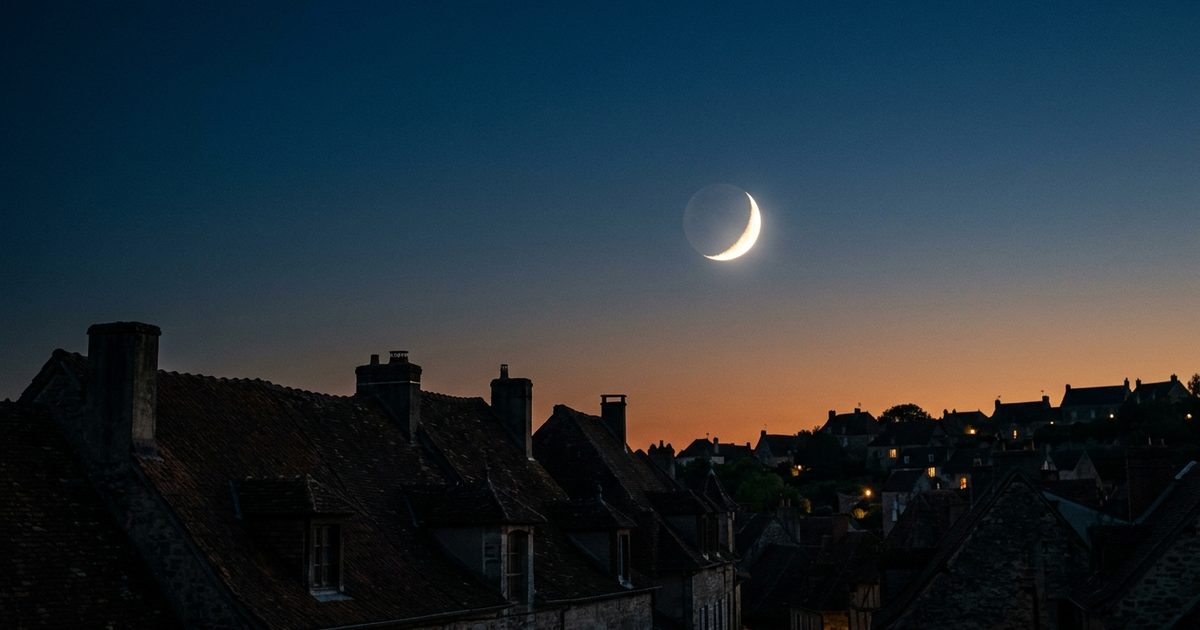
The moon is the least punctual object in the sky. Meet it over the rooftops at 9 pm tonight, and tomorrow it will stand you up until nearly 10. Within a week the appointment has slid past midnight, and the evening sky seems to have lost it entirely. The drift follows one clean rule, and this very week offers the best exception to it.
Why does the moon rise later every day?
The short answer: the moon orbits Earth in the same direction Earth spins, advancing about 13 degrees along its orbit each day. After one full rotation, Earth must spin through that extra arc, roughly 50 minutes’ worth, before the moon clears the horizon again. The sun demands only 4 extra minutes a day, so solar time stays regular while the moon drifts around the clock.
The mechanism is a race with a moving finish line. Earth turns once, but the moon has moved on, one twenty-seventh of its orbit further east, its full lap taking 27.3 days. Thirteen degrees of extra rotation cost about 50 minutes at the equator’s pace of 4 minutes per degree.
The sun plays the same game on a gentler setting. Earth’s yearly orbit shifts the sun about one degree per day, the 4-minute difference explaining why a day is not exactly 24 hours of pure rotation. The moon simply runs the same mechanism thirteen times faster.
The 50 minutes that are almost never 50
The average hides a wide swing. Depending on the angle the moon’s path makes with your local horizon, the daily delay ranges roughly from 20 to 80 minutes at mid-northern latitudes. When the moon’s track meets the evening horizon at a steep angle, its daily step eastward drops it far below the horizon, and the delay stretches. When the track lies shallow, the step slides sideways along the horizon, and the delay shrinks.
This week is the shrinking season’s showcase. Around the September equinox, whose exact timing we covered, the evening ecliptic lies at its shallowest, the delay drops to 25-35 minutes, and the nearly full moon rises at dusk several nights running. That is the whole secret of the harvest moon, rising at dinner time from Friday through Sunday.
Spring evenings sit at the other extreme. The steep March ecliptic stretches the delay toward 80 minutes, and the evening moon vanishes from one night to the next, to the bafflement of casual skywatchers.
What the drift explains, from daytime moons to vanishing evenings
The wandering schedule solves several everyday mysteries. The daytime moon first: since moonrise slides all around the clock, the moon spends about half its up-time above the horizon in daylight, and a first-quarter moon rising near midday is perfectly normal, not an anomaly.
The full moon’s punctuality second. Sitting exactly opposite the sun, a full moon must rise at sunset and set at sunrise, the one night its schedule is locked to ours. Each following night it slips 30 to 70 minutes deeper into the evening, which is why the big low moon everyone photographs seems gone within a week, precisely as darkness itself arrives earlier, on the schedule tracked in what time it gets dark.
The tides third, as a bonus. High tides follow the moon’s passage, and they too arrive about 50 minutes later each day, fishermen and surfers reading the same celestial clock as the moonwatchers.
The one-week experiment worth trying
The drift makes a fine backyard measurement. Note the moon’s rise over a fixed landmark tonight, repeat tomorrow, and the delay reveals itself within a quarter hour’s accuracy. Do it this weekend and the harvest moon will show you the minimum, barely half an hour. Try again in March and the same experiment yields more than an hour.
The moon’s lateness is, in the end, the most visible proof of its motion. Nothing else in the night sky shows you an orbit with the naked eye, one missed appointment at a time. The moon is not unpunctual, it is simply going somewhere, thirteen degrees a day, and the delay is its travel diary.
Vos questions
Why does the moon rise later each day?
Because the moon orbits Earth in the same direction Earth spins : it moves about 13 degrees along its orbit every day, and Earth must rotate that extra arc, roughly 50 minutes' worth, to bring it back over the horizon. The sun only requires an extra 4 minutes, which is why solar days stay regular while moonrise drifts.
Is the moonrise delay always 50 minutes?
No, 50 minutes is only the average : depending on the angle the moon's path makes with your horizon, the delay swings roughly between 20 and 80 minutes at mid-northern latitudes. It shrinks near the September equinox, the harvest moon effect, and stretches in spring evenings.
Why can I see the moon in the daytime?
Because the 50-minute drift pushes moonrise all around the clock : outside the full moon, the moon spends about half of its hours above the horizon in daylight. A first-quarter moon rises around midday and a waning moon hangs in the morning sky, bright enough to shine through the blue.
Why does the full moon always rise at sunset?
By geometry : a full moon sits exactly opposite the sun, so it must come up as the sun goes down and set as the sun rises. Each day after full, moonrise slips later into the night, which is why the evening moon seems to disappear the following week.