The harvest moon will rise at dinner time for several nights
Par Sam Arkwell · publié le 23 septembre 2026
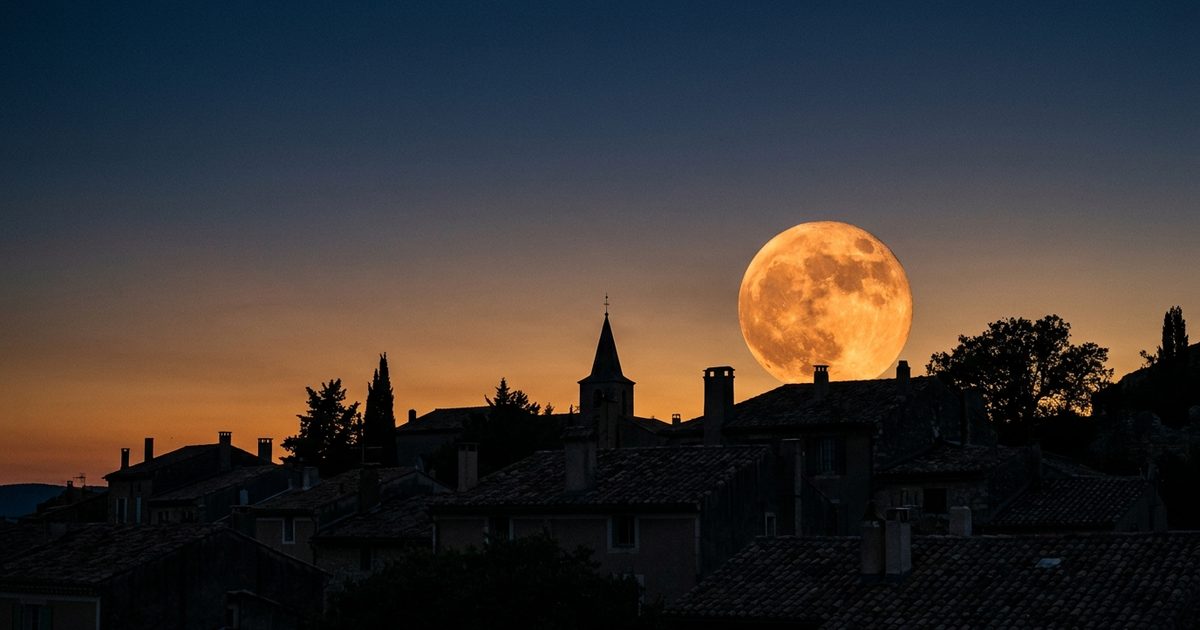
On Saturday evening, a huge orange disk will climb due east right around dinner time. Then comes the strange part: the scene repeats on Sunday at nearly the same hour, and again on Monday. The most famous full moon of the year owes its fame to this small feat of celestial clockwork.
Why does this moon rise at the same time night after night?
The short answer: the moon normally rises about 50 minutes later each night. Around the September equinox, its path makes a very shallow angle with the evening horizon, so its daily motion shifts it along the horizon instead of below it. The nightly delay drops to roughly 25-35 minutes at mid-northern latitudes, and a nearly full moon keeps rising near dusk for several evenings.
Start with the usual routine. The moon moves about 13 degrees along its orbit every day, and Earth must rotate that extra arc to bring it back above the horizon. Hence the familiar 50-minute daily delay that scrambles moonrise times across a week.
Autumn breaks the routine. Near the equinox, the moon’s track skims the evening horizon at a grazing angle, the same geometry that made fall start at an oddly precise minute this week. The daily shift slides sideways along the horizon rather than sinking below it, and the delay melts to nearly half.
Dinner time, three nights in a row
The weekend schedule writes itself. The exact full moon lands on Saturday, September 26, and from Friday through Sunday the disk will rise due east within the hour after sunset. Three evenings running, the moon clocks in at dusk, at a time of year when darkness already falls surprisingly early.
The precise minute depends on where you stand. As with sunset, eastern cities in a time zone are served before western ones, and the gap runs to half an hour across a wide country. In short, the appointment shifts by minutes from town to town, but always lands between the main course and dessert.
The name comes straight from that quirk. Before electricity, this cooperative moon extended the harvesters’ working light exactly when the crops demanded it, evening after evening. Farming communities gave it the finest nickname on the lunar calendar.
Huge and orange, two effects for one show
Size first, and it is the surprise of the story. The horizon moon measures no larger than the overhead moon, its angular size staying almost constant. The impression of enormity is the moon illusion, a purely psychological effect, the brain comparing the disk with rooftops and trees. A fixed-zoom photo debunks it on every attempt, to general disappointment.
The color, however, is real. Low on the horizon, moonlight crosses a much thicker slice of atmosphere, which scatters away the blue and lets the orange through, the exact mechanism behind sunsets and golden hour. So the rising show combines a real filter with a fake magnifying glass, the duo that floods social feeds every fall.
The most photogenic window lasts about twenty minutes, while the disk brushes the rooftops. Then the moon climbs, whitens, and goes back to being the ordinary lamp of clear nights.
The appointment to keep this weekend
The plan takes three lines. Check your local sunset time, face east within the following quarter hour, and let the moon make its entrance. No instrument required, the show works with the naked eye, right in equilux week, when day and night balance out.
Miss Saturday and Sunday offers a rerun, which is the real magic of this particular moon. It is the only full moon of the year that grants catch-up sessions, at dinner time, just as it did in the harvest fields.
Vos questions
What is the harvest moon?
It is the full moon closest to the September equinox, this year the one on Saturday, September 26. The name comes from farming days: this moon rises near dusk several evenings in a row, and its light once let harvesters keep working after sunset during the busiest weeks of the year.
Why does the harvest moon rise at almost the same time each night?
On average the moon rises about 50 minutes later each night. Around the September equinox, the moon's path makes a very shallow angle with the evening horizon: its daily motion shifts it along the horizon rather than below it. At mid-northern latitudes the delay drops to roughly 25-35 minutes, so a nearly full moon rises near dusk night after night.
What time should I watch the harvest moon?
Within the hour after your local sunset, from Friday through Sunday: the moon will climb due east shortly after dusk, looking huge and orange while it stays low. The exact minute shifts with your location, eastern cities in a time zone seeing it before western ones, just as with sunset times.
Why does the moon look so big when it rises?
That is the moon illusion, a purely psychological effect: near the horizon, your brain compares the moon with trees and rooftops and reads it as enormous. Its actual angular size barely changes, as any fixed-zoom photo proves. The orange tint is real, though: the thick slice of atmosphere filters out the blue light.