Why fall starts tonight at such an oddly precise minute
Par Sam Arkwell · publié le 22 septembre 2026
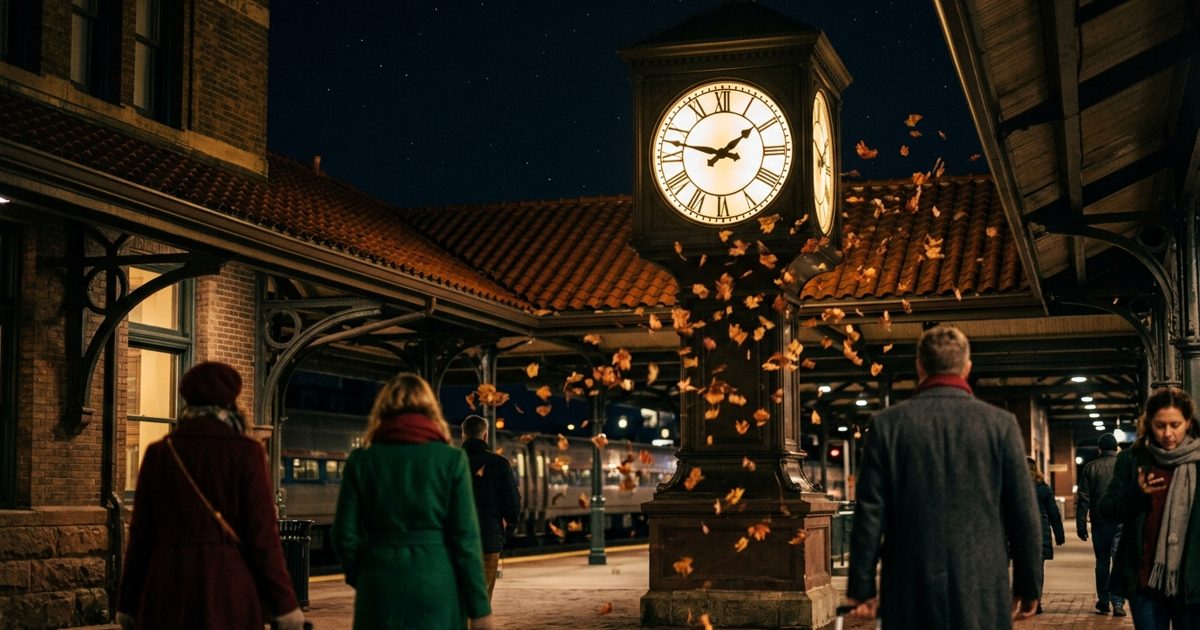
Tonight, while half the world sleeps, summer will hand over the keys. At 00.05 UTC exactly, which reads 8.05 pm in New York. A season starting at five past the hour sounds like a scheduling glitch. In fact, it is the opposite of one.
Why does fall start at such a precise minute?
The short answer: the equinox is an astronomical event, not a convention. At 00.05 UTC, the Sun’s center crosses the celestial equator, the geometric instant that defines the start of fall. That instant is single, planetary and computable to the minute. It simply has no reason to land at midnight, which is a human invention.
The confusion comes from our calendars. Administrative seasons start on fixed dates, while astronomical seasons start at an instant. So fall does not begin “on September 23”, it begins at one precise moment, which every time zone labels its own way. Our piece on the exact equinox time laid out that principle.
The geometry behind the instant is elegant. Earth circles the Sun with a tilted axis, and twice a year the Sun crosses the equator’s plane. A crossing lasts what a crossing lasts, an instant.
Why the hour moves every year
Last year the equinox struck at a different hour, and next year it will again. The reason fits in one number, because the seasonal year runs about 365 days and 6 hours. Each 365-day calendar year therefore finishes nearly 6 hours behind the sky, and the equinox drifts later by the same amount.
The calendar corrects the drift in jolts. Every fourth year, the leap day yanks the equinox back a full day at once. As a result, the equinox hour draws a sawtooth, three years sliding 6 hours forward, one year jumping 24 back. That dance keeps the date bouncing between September 22 and 23.
The pattern also explains the records. Some years push the equinox late into the 23rd, others pull it early into the 22nd, and the cycle repeats every four years with a slow century-scale creep.
One instant, twenty-four different clocks
At 00.05 UTC tonight, fall begins for the whole planet at once. The world’s calendars, however, will disagree politely. New York lives the moment at 8.05 pm, still September 22. Paris lives it at 2.05 am on the 23rd. Tokyo gets it at 9.05 in the morning. One instant, sliced by time zones.
This produces a charming paradox. Depending on the country, fall 2026 starts on the 22nd or the 23rd, and both answers are correct. The instant is unique, its local label is not, exactly like this week’s due-west sunsets sweeping across the map.
What tonight changes, and what it does not
At 00.06 UTC, nothing outside will look different. Days will keep shrinking at the same pace, the fastest of the year. True day-night equality waits a few more days, since the equilux follows its own schedule around September 26.
The equinox remains the real pivot, the one the math points to. Tonight, at five past midnight universal time, the northern hemisphere officially enters its dark half. The online clock will happily show you the exact second, in your own time zone, and the spring crossing already has its appointment, March 20, at an hour just as precise and just as unround.
Vos questions
Why does fall start at a precise minute?
Because the equinox is an astronomical instant, not an administrative date: the moment the Sun's center crosses the celestial equator. This year that instant lands on September 23 at 00.05 UTC, which is 8.05 pm on the 22nd in New York. It has no reason to coincide with midnight, a human convention.
Why does the equinox time change every year?
Because the seasonal year lasts about 365 days and 6 hours: each calendar year ends nearly 6 hours behind the sky, so the equinox drifts later by that amount. Every fourth year, the leap day pulls it back a full day. The sawtooth keeps the date bouncing between September 22 and 23.
Does the equinox happen at the same moment everywhere?
Yes: it is one planetary instant, 00.05 UTC tonight. Only its local label changes with time zones, 8.05 pm on the 22nd in New York, 2.05 am on the 23rd in Paris, 9.05 am in Tokyo. Some countries file this equinox under September 22, others under the 23rd, for the same moment.
Can the September equinox fall on other dates?
Over centuries, September 21 and 24 are possible at the extremes of the leap-year cycle, but they are rare. For the current decades, the September equinox alternates between the 22nd and the 23rd, at hours that creep around the clock.