When is golden hour today, the simple rule photographers use
Par Sam Arkwell · publié le 16 septembre 2026
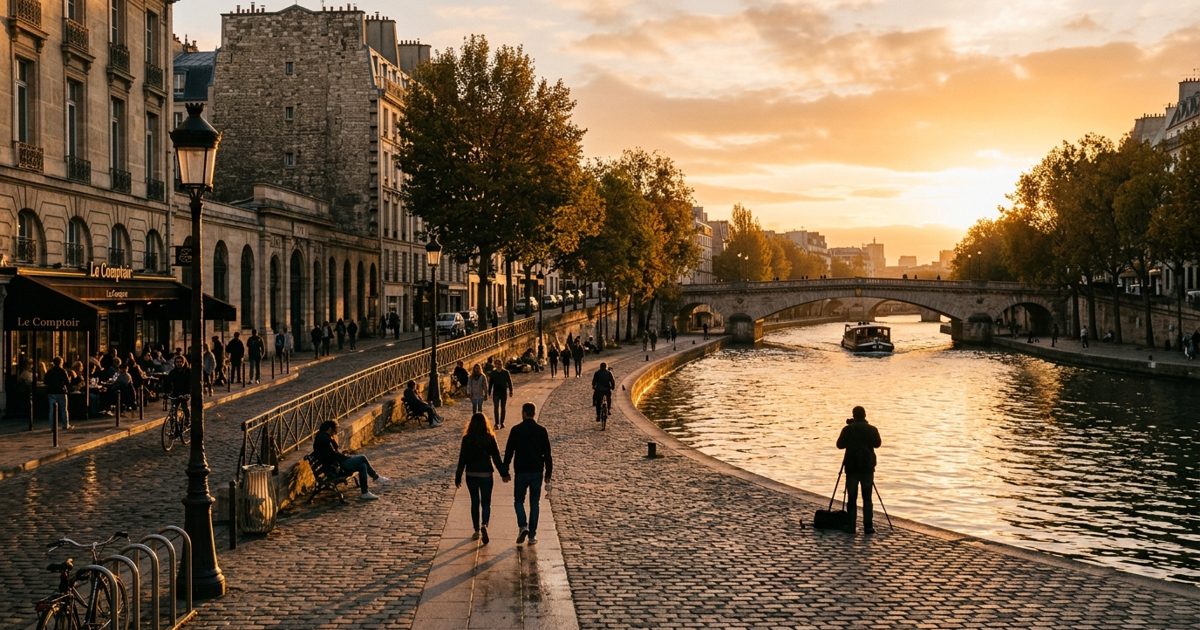
The short answer: golden hour is roughly the last hour before your local sunset, and blue hour is the half hour right after it. The pocket rule works anywhere: look up tonight’s sunset, subtract an hour for gold, add thirty minutes for blue. A 7 pm sunset means gold from about 6 to 7, blue until about 7:30. And this fortnight is the connoisseur’s season: around the equinox the Sun dives at its steepest angle of the year, compressing both windows into their briefest, most intense version, at the most convenient clock times of the year.
Why the light behaves this way, how to compute the windows anywhere, and how to use the equinox weeks.
Two lights, one geometry
Golden hour and blue hour are not photographers’ moods: they are two optical regimes, defined by the Sun’s height. Gold first: when the Sun drops below about ten degrees of elevation, its rays cross several times more atmosphere than at noon. The blue wavelengths scatter away along that longer path, leaving the warm end of the spectrum, and the grazing angle stretches shadows, models every surface, and softens contrast. It is the light that flatters everything, faces, buildings, landscapes, and its evening window covers roughly the last hour before sunset, with a morning twin in the hour after sunrise.
Blue second: once the Sun has set, it keeps lighting the sky from below the horizon. Through civil twilight, the half-hour buffer our what-time-does-it-get-dark guide mapped out, light becomes a deep, even blue with no shadows at all, while streetlights and windows switch on: the minutes when cities look lit from within. Blue hour is not a lesser golden hour; it is its optical opposite. Gold sculpts, blue envelops, and they run back to back with no intermission.
The pocket rule, and what changes it
Both windows hang off a single number, your local sunset time, printed in every weather app. The rule: gold = sunset minus one hour; blue = sunset plus thirty minutes. A 7:04 pm sunset yields gold from about 6 to 7 and blue until about 7:35. The same arithmetic works at dawn in mirror image, blue before sunrise, gold after, for the early risers who get the same show with empty streets.
What the rule cannot hide is that “hour” is an approximation, and the true length swings widely: it depends on how fast the Sun sinks, hence on latitude and season. Near the solstices the Sun crosses the horizon obliquely and the windows dawdle, the endless golden evenings of June, or, near the poles, entire nights of amber. Around the equinoxes, the Sun dives at the year’s steepest angle: at mid-latitudes, golden hour compresses to about 40 minutes and blue hour to about 25, brief, dense, saturated. That steep dive is the same mechanism that is currently pulling darkness earlier at the year’s fastest rate: one geometry, two consequences.
Why the equinox fortnight is the sweet spot
Here is the paradox that fills riversides with tripods every September: the equinox gives shorter windows, and photographers love it anyway, for three practical reasons. The clock times, first: June’s golden hour demands a 9:30 pm session and December’s falls at 4:30 pm in the middle of work, while September’s sits at the most civilized slots of the year, early evening after work, mid-morning-adjacent at dawn. The intensity, second: a compressed window concentrates its color shift, the light visibly changing minute by minute, which makes for dramatic sequences and forgives nothing, part of the appeal. The skies, third: late summer’s stable weather still delivers clear evenings, with the first autumn color arriving as a bonus.
Using the fortnight well takes three habits. Arrive early: a 40-minute window spends no time waiting for you, and the quarter hour before gold is for setup. Stay through the handover: the gold-to-blue transition, ten minutes when streetlights ignite inside the last warm reflections, is the most photogenic slice of the whole evening. Check the exact minute: sunset times shift by one to two minutes a day in this season, and the equinox itself lands on September 23 at 00:05 UTC to keep things punctual; our online clock holds the reference time while the sky does the rest. And for everyone who never mounts a camera: the rule still pays. Sunset minus one hour, tonight and every night, the sky performs its full program, gold then blue, admission free, best seats outside.
Vos questions
When is golden hour today?
Roughly the last hour before your local sunset (and the first hour after sunrise). Find tonight's sunset time on any weather app and subtract an hour: with a 7 pm sunset, golden hour runs from about 6 to 7 pm. The exact span varies with latitude and season, shorter near the equator and around the equinoxes, longer in midsummer and toward the poles.
What is blue hour?
The stretch just after sunset (or before sunrise) when the Sun lights the sky from below the horizon: light turns deep, even blue, shadows disappear, and city lights come on. It matches civil twilight, roughly 25 to 35 minutes at mid-latitudes, and it follows golden hour with no intermission.
Why does the light turn golden before sunset?
Because the low Sun shines through many times more atmosphere than at noon: the blue wavelengths scatter away en route, leaving warm gold and red tones, while the grazing angle stretches shadows and softens contrast. It is pure atmospheric geometry, repeated every clear day.
Does golden hour really last an hour?
Rarely exactly: its length depends on how fast the Sun sinks, so on latitude and season. Around the equinoxes the Sun dives at its steepest angle and golden hour compresses to about 40 minutes at mid-latitudes, brief and intense; in midsummer it stretches well past an hour, and near the poles it can last all evening.