Why is it getting dark so early, the September light drop explained
Par Sam Arkwell · publié le 15 septembre 2026
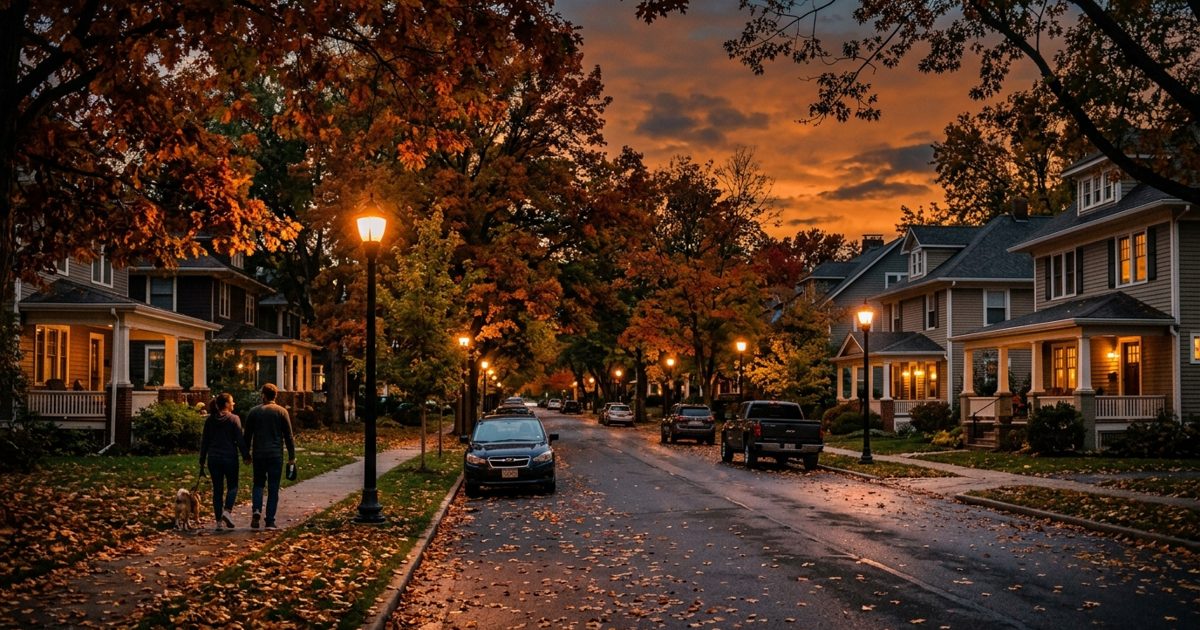
The short answer: you are living through the steepest daylight drop of the year. Around the September equinox, mid-latitudes lose 2 to 4 minutes of daylight per day, half of it at sunset: three weeks of that stacks into a full hour of earlier darkness, which is exactly why evenings suddenly feel amputated. It is not your imagination and not an anomaly; it is orbital clockwork at its annual maximum speed. The slide slows after the equinox, but two calendar jolts remain: the clock change in late October (Europe) and early November (US), each yanking sunset another hour earlier overnight.
The mechanics of the plunge, the numbers by latitude, and the six-week outlook.
The steepest slope of the year, by the numbers
Daylight does not drain at a constant rate: it follows a wave through the year, nearly flat at the solstices and steepest at the equinoxes. June loses seconds a day; mid-September loses minutes. The figures by latitude tell the story: around 30-35°N, the southern US, the daily loss runs near 2 minutes; around 40-45°N, New York, Chicago, Rome, it reaches roughly 3; by 50°N and beyond, London, Berlin, most of Canada, 4 minutes and more vanish every 24 hours. Compound that over a month and the ledger reads an hour and a half of lost daylight at northern latitudes: the evening walk that ended in sunshine on Labor Day now ends under streetlights.
The perception of suddenness has a precise cause: memory lags the calendar. Human routines anchor to light cues, dinner before dusk, a run after work, and those cues held steady through the flat summer weeks. September breaks them at maximum speed, so every routine snaps within days of each other, and the change registers as abrupt even though the equinox, striking on September 23 this year, arrives exactly on schedule, as it has for four and a half billion years.
Why the equinox is the fast lane
The mechanism draws in one image: Earth’s axis stays tilted 23.4 degrees while the planet orbits the Sun, so the boundary between light and dark sweeps across latitudes through the year. Near the solstices, your latitude sits near the extremes of that sweep, where day length changes crawl. Near the equinoxes, you are crossing the middle of the swing, where the change moves fastest, the same way a pendulum sweeps quickest through the center of its arc. Mid-September is the middle of the arc: hence the sprint.
Two details sharpen the picture. The loss splits between the ends of the day, sunrises later, sunsets earlier, each by 1 to 2 minutes daily, but evenings absorb the felt cost, the morning loss falling mostly on sleep. And twilight itself, the grace period between sunset and darkness whose 30-minute rule we covered yesterday, is simultaneously at its annual shortest, because the equinox sun dives below the horizon at the year’s steepest angle. Earlier sunset plus faster dusk: the double effect is why September night does not fall, it slams.
The six-week outlook: slower slide, two big jolts
The good news, such as it is: the equinox is the peak of the slide. From late September the daily loss decelerates, week after week, until day length bottoms out at the December solstice and turns. The perceived calendar, though, has two jolts still to come, both man-made: the end of daylight saving time, late October in Europe and November 1 in the US as our clock-change guide details, will each shift sunset a further hour earlier overnight, moving darkness from after the commute to the middle of it. Between now and mid-November, a New Yorker’s sunset migrates from about 7 pm to about 4:40 pm, one orbital hour and one legislated hour combined.
What to do with the numbers is mostly a matter of expectations management: move outdoor routines earlier by fifteen minutes a week to stay ahead of the curve, catch morning light deliberately as the season’s scarcest resource, and date the last after-work daylight activities of the year, their window closes within weeks. For the exact minute of tonight’s curtain wherever you live, sunset plus thirty on any weather app, or our online clock for the reference time while you check. And if the early dark still feels personal, one consolation from the celestial ledger: the account reverses in December, and by March it will be paying back at this exact same maximum speed, in your favor.
Vos questions
Why is it getting dark so early all of a sudden?
Because mid-September sits at the year's steepest daylight slide: around the equinox, mid-latitudes lose 2 to 4 minutes of daylight every single day, about half of it in the evening. Over three weeks that adds up to an hour of earlier darkness, fast enough to feel sudden even though it is perfectly on schedule.
How much daylight are we losing per day right now?
Depends on latitude: roughly 2 minutes a day around 30-35°N (southern US), about 3 minutes around 40-45°N (New York, Chicago, southern Europe), and 4 or more toward 50°N and beyond (London, Berlin, Canada). The farther from the equator, the steeper the September slide.
When will it stop getting dark earlier?
The slide continues until the December solstice, but it decelerates after the equinox: the daily loss shrinks week by week. Two extra jolts remain on the calendar: the end of daylight saving time (early November in the US, late October in Europe) shifts sunset a full hour earlier overnight.
Is the light loss the same morning and evening?
It splits roughly in half: sunrises get later while sunsets get earlier, each by 1 to 2 minutes a day. Evenings feel it more because the loss lands on waking, social hours, while the morning loss mostly falls on time spent asleep.